2025 Long-term Fiscal Projection
2025 Long-term Fiscal Projection
The Federal Minister of Finance is, pursuant to Section 15(2) of the Federal Budget Act 2013, required to prepare, every three years, a well-grounded and transparent long-term fiscal projection covering a period of at least 30 years.
The 2025 report is shaped by the impact of the COVID-19 pandemic, the energy crisis, the inflation surge, and the economic downturn on public budgets, as well as the subsequent period of budget consolidation.
Results clearly demonstrate the necessity for the Federal Government to initiate budget consolidation, and the significance of continuing this consolidation effort.
Links and downloads
- 2025 Long-term fiscal projection (PDF, 2 MB)
- German version: Langfristige Budgetprognose 2025 (PDF, 1 MB)
- Datendownload (2 MB) (German version only)
- WIFO-Studie "Langfristige Perspektiven der öffentlichen Finanzen in Österreich" (German version only)
- UBA-Studie "Treibhausgas-Szenarien für die langfristige Budgetprognose 2025" (German version only)
Without consolidation measures, the debt-to-GDP ratio would rise to more than 250% by 2060. Under the currently adopted budgetary framework up to 2029, the debt-to-GDP ratio is reduced to below 150% by 2060.
Continued consolidation in line with European fiscal requirements until 2031 stabilises the debt-to-GDP ratio at around 90% by 2060, considering demographic developments and the impacts of climate change.
Key long-term factors in public debt development are interest expenditures, which could increase sharply with higher debt ratios. Halting this dynamic is the central objective of budget consolidation.
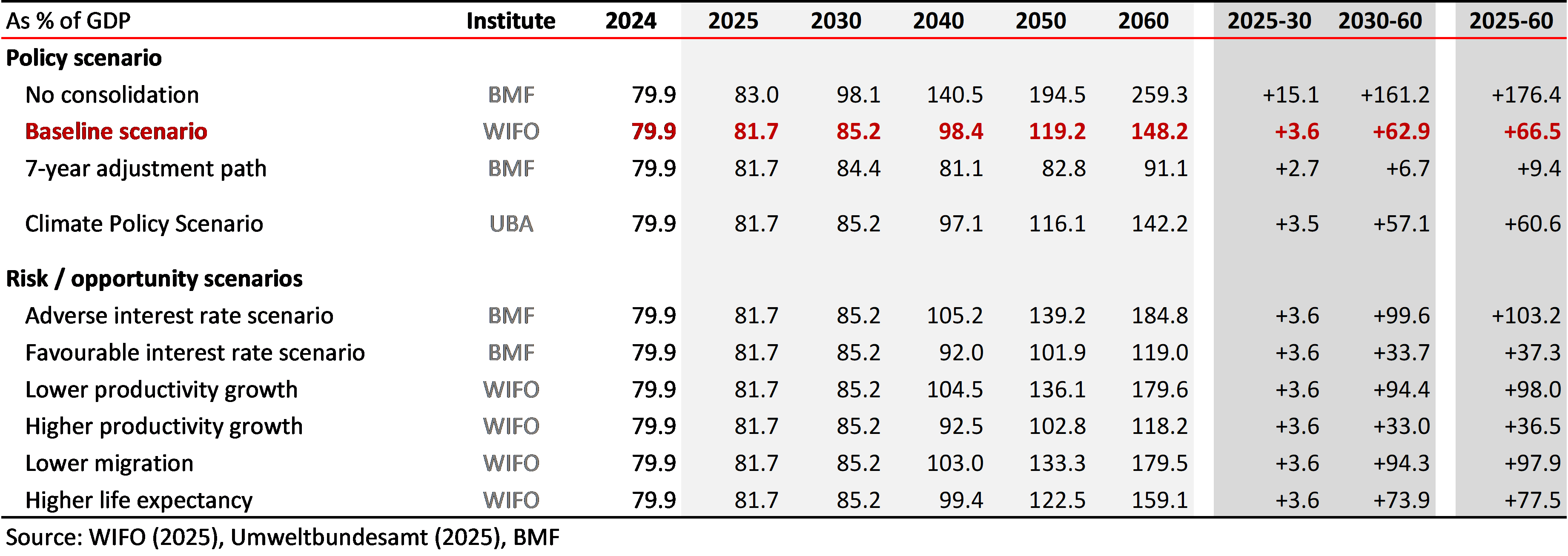
In a climate policy scenario consistent with the Government Programme (Coalition Treaty), the analysis shows that impact-driven and efficient action in this policy area can further reduce the debt ratio. Under the climate policy scenario, both the need for emission certificate purchases and macroeconomic damages, as a result of enhanced adaptation measures, can be significantly reduced.
Results of the baseline scenario: In the baseline scenario of the Long-term Fiscal Projection, increases in pension expenditure show sustained momentum, particularly up to 2035. Expenditures on education and family benefits decline slightly due to demographic effects.
Expenditures on health and long-term care increase over the long-term, with expenditure ratios rising by 1.3 percentage points of GDP in each case compared to 2025.
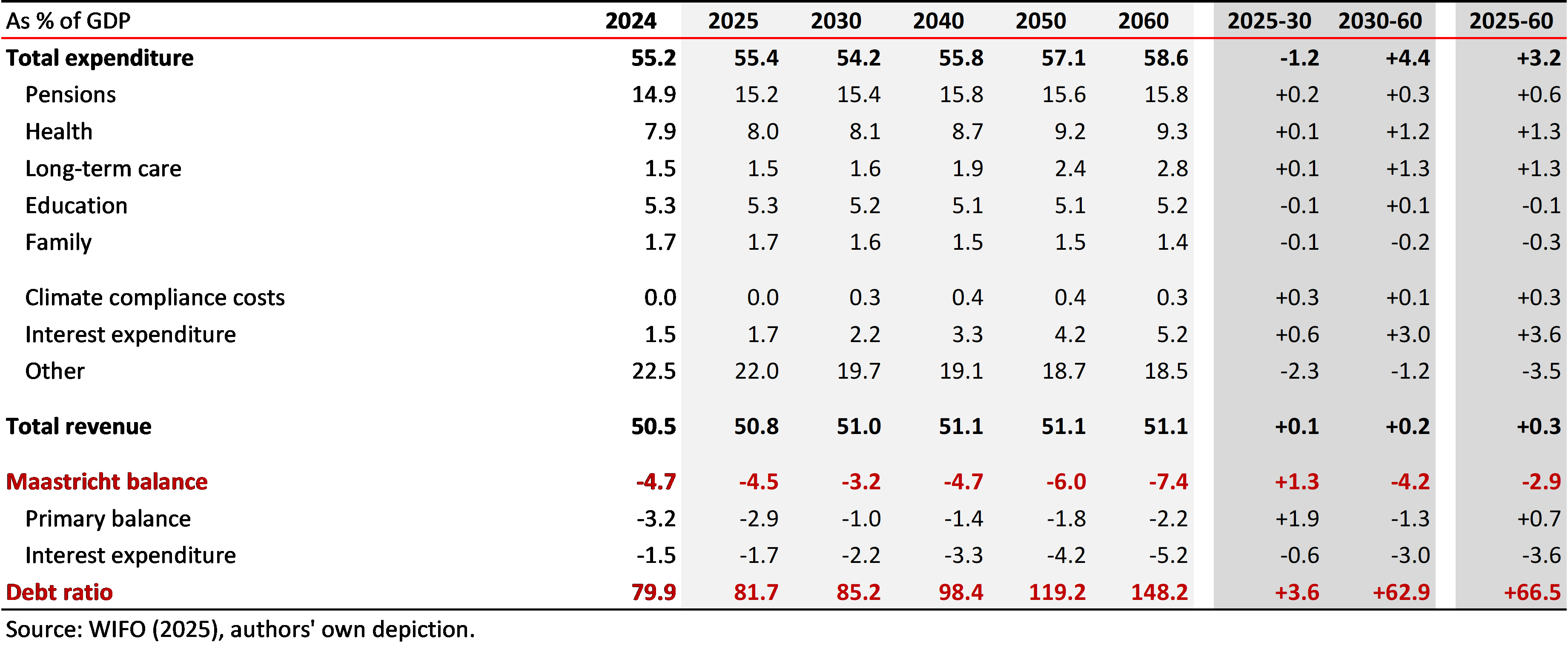
Climate compliance costs in the baseline scenario, without additional measures, result in costs of 0.3% to 0.4% of GDP per year.
Interest expenditure increases by 3.6 percentage points of GDP by 2060, increasingly constraining fiscal space. In addition to the development of the primary balance and the debt-to-GDP ratio, interest expenditure is highly sensitive to the assumed interest rate. This relationship is examined in a dedicated alternative scenario.
The report is based on results of studies conducted by the Austrian Institute of Economic Research (WIFO) and Environment Agency Austria (Umweltbundesamt).